

Can Fatty Liver be Reversed?
For many people with MASLD (metabolic dysfunction-associated steatotic liver disease), especially before advanced liver fibrosis develops, the answer is encouraging: liver fat and metabolic health can improve significantly with sustained lifestyle changes.
Weight loss, a Mediterranean-style diet, regular exercise, better meal timing, quality sleep and limiting alcohol can all play an important role.
Here are 5 science-backed lifestyle strategies that can help improve fatty liver and protect your long-term metabolic health.
Fatty liver is often discovered unexpectedly—during an ultrasound, routine blood test or health check when a person, otherwise, feels perfectly well.
That is exactly why it deserves attention.
MASLD, previously called NAFLD, is strongly associated with obesity, insulin resistance, type 2 diabetes, abnormal cholesterol and cardiovascular disease.
When excess liver fat is accompanied by inflammation and liver cell injury, the disease can progress to MASH (metabolic dysfunction-associated steatohepatitis) and, in some people, fibrosis and eventually cirrhosis.
But there is an encouraging side to this story:
The liver has a remarkable capacity to recover.
For many people—particularly when MASLD is identified before advanced fibrosis develops—meaningful lifestyle changes can substantially reduce liver fat and improve overall metabolic health. And the strategy doesn’t have to be complicated.
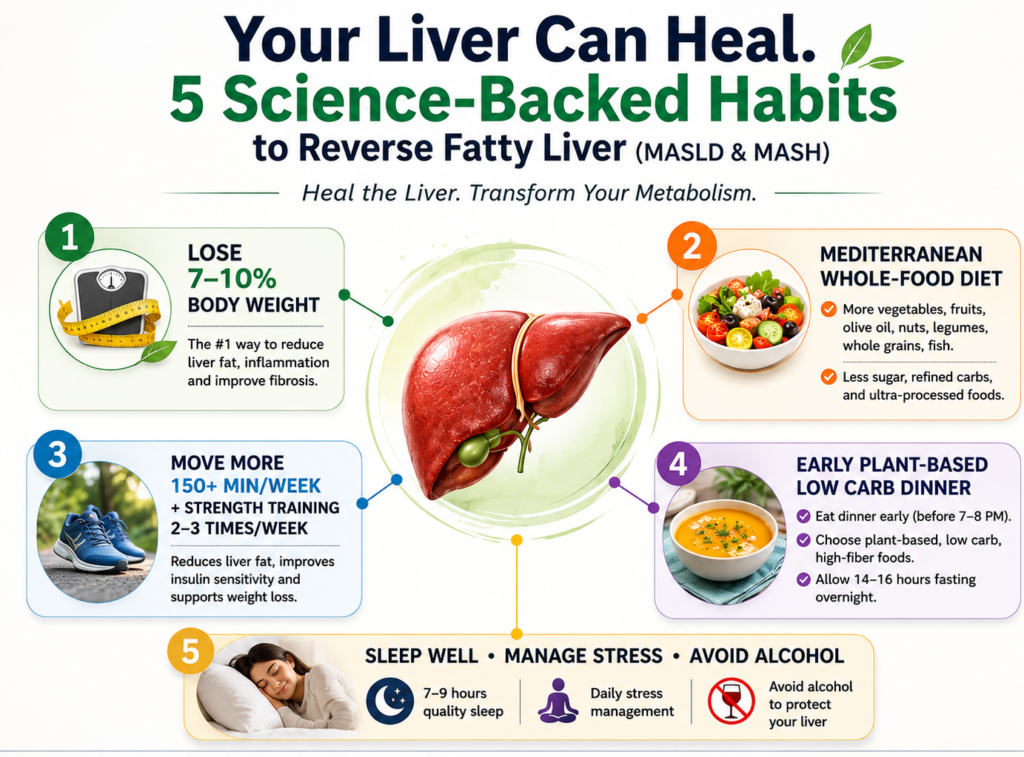
1. Lose 7–10% of Your Body Weight ⚖️
For people who are overweight or living with obesity, sustained weight loss is among the most effective interventions for fatty liver.
Even modest weight reduction can decrease liver fat. Greater sustained weight loss—often around 7–10% or more of initial body weight—is associated with greater improvements in liver inflammation and, in some patients, fibrosis. But the key word is sustainable. A diet you can follow for years is usually more valuable than an extreme diet you can tolerate for four weeks.
Think progress, not perfection.
2. Follow a Mediterranean-Style Whole-Food Diet 🥗
You don’t need a special “liver detox.”
Your liver is already one of the body’s most sophisticated metabolic and detoxification organs. It needs a healthier environment. Build most meals around vegetables, whole fruits, legumes, nuts, seeds, appropriate portions of whole grains, fish, and other lean proteins, using extra-virgin olive oil as a major fat source. At the same time, reduce:
Sugary drinks • refined carbohydrates • ultra-processed foods • processed meats • excess saturated fat
A Mediterranean-style eating pattern doesn’t only support liver health. It can also improve insulin sensitivity, blood glucose, lipids and cardiovascular risk.
3. Exercise at Least 150 Minutes Each Week 🏃
Exercise is medicine for the metabolic system.
Aim for at least 150 minutes of moderate-intensity physical activity per week, such as brisk walking, cycling or swimming.
And don’t forget your muscles.
Add resistance or strength training 2–3 times per week.
Skeletal muscle plays an important role in glucose disposal and insulin sensitivity. Maintaining muscle becomes particularly important during weight loss.
Another important point:
Exercise can improve liver fat even without dramatic weight loss.
So don’t judge the benefits of physical activity only by the number on your weighing scale. Your metabolism may be improving even when your weight changes slowly.
4. Consider an Early Plant-Based, Lower-Carbohydrate Dinner 🌙
What we eat matters. Increasingly, research also suggests that when we eat may influence metabolic health.
One practical strategy is to make dinner earlier and lighter, emphasizing vegetables, legumes and other fibre-rich plant foods while reducing refined carbohydrates.
For appropriate individuals, this may be combined with a 14–16-hour overnight fasting window.
For example, finishing dinner early and delaying the next caloric meal naturally extends the overnight fasting period.
Time-restricted eating may help some people reduce calorie intake and body weight and improve metabolic parameters.
However, intermittent fasting should be viewed as a useful tool—not a miracle treatment for fatty liver.
The strongest foundations remain sustainable weight loss, high-quality nutrition and regular physical activity.
Fasting is also not appropriate for everyone, particularly some people taking glucose-lowering medications or those with certain medical conditions. It should therefore be individualised.
5. Sleep Well, Manage Stress and Limit Alcohol 😴
Metabolic health doesn’t stop when you leave the gym.
Aim for approximately 7–9 hours of quality sleep each night.
Chronic sleep deprivation can adversely affect appetite regulation, insulin sensitivity and weight management.
Stress matters too. Walking, meditation, breathing exercises, spending time outdoors and maintaining meaningful relationships can all contribute to a healthier metabolic lifestyle.
And if you already have fatty liver—particularly MASH or significant fibrosis—alcohol consumption deserves serious attention and may need to be avoided completely depending on individual circumstances.
Fatty Liver Is More Than a Liver Problem
One of the biggest misconceptions about fatty liver is that it affects only the liver. Often, it is a visible manifestation of something much broader:
Metabolic Dysfunction and insulin Resistance.
That helps explain why MASLD frequently coexists with the following:
- Abdominal obesity
- Prediabetes
- Type 2 diabetes
- High triglycerides
- Abnormal cholesterol
- Hypertension
- Cardiovascular disease
Therefore, the goal shouldn’t simply be to make the next ultrasound look better.
The bigger objective is to improve the entire metabolic system.
The Liver-Health Formula
Healthy weight + better food + regular movement + sensible meal timing + quality sleep + minimal alcohol
None of these sounds revolutionary. And that’s precisely the point.
We sometimes search for complicated solutions while underestimating the extraordinary biological effect of ordinary habits repeated consistently.
This is what I describe as Health Wisdom in my book Decoding Wisdom – Your Blueprint for Supreme Life.
Knowing what is healthy is only the beginning.
“Real wisdom begins when knowledge becomes action—and action becomes a way of life.“
Your liver doesn’t need perfection.
It needs better signals, delivered consistently.
Heal the liver. Improve the metabolism. Protect the future. 💚
Medical note: This article is for general health education and is not a substitute for individual medical advice. People with diabetes, established liver disease or those taking medication should discuss major dietary or fasting changes with their healthcare professional.